The 5 Free Certificates to Get First (and in What Order)
You just opened the Free Certificate Directory, saw more than 40 options, and felt the paralysis set in. I’ve been through that list line by line, and I don’t think you need all 40. I think you need 5, in a specific order, and then you need to stop planning and start doing them.
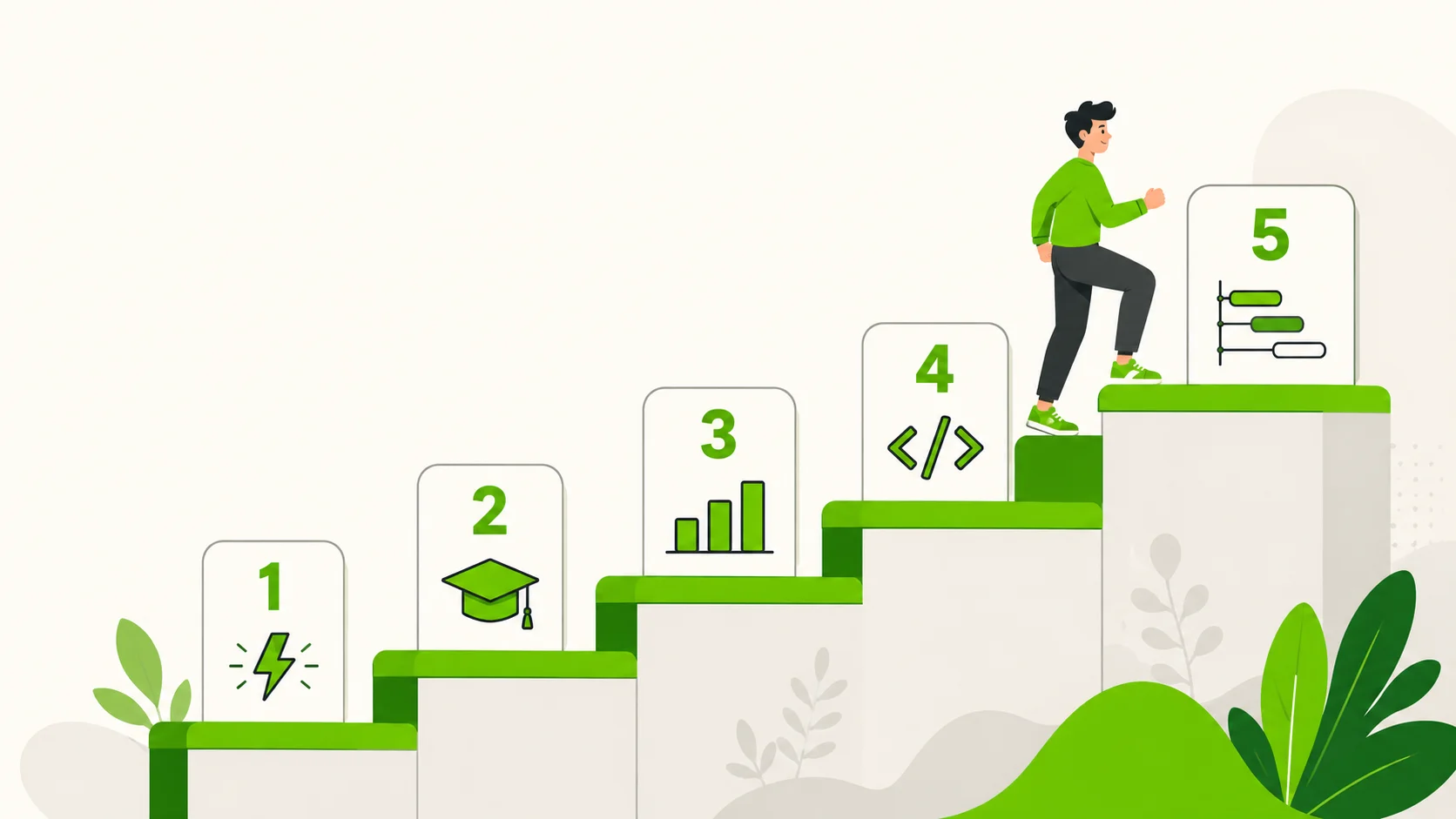
Here’s the order I recommend: (1) a same-day quick win through Google Skillshop, (2) the Harvard CS50 Certificate for a name recruiters already recognize, (3) a Google Career Certificate in your target field, (4) a freeCodeCamp certification to prove you can actually build something, and (5) Google Project Management to open a second track. The logic isn’t random — it goes from fastest visible result, to most recognizable brand, to progressively deeper and harder credentials. Each one gives you something the next one needs: confidence, then a name, then depth, then proof, then a second lane.
Before You Start: How to Spot a Fake Certificate Site
Before you hand an email address, a credit card, or any personal information to a site promising a “certificate,” run it past this checklist. I’ve seen every one of these tricks used on people chasing the exact same 5 credentials below.
- The domain isn’t a .edu, a .org, or a platform you already recognize (Coursera, edX, Google, LinkedIn Learning) — yet it’s selling an “instant certificate” carrying a famous university’s name.
- There’s no actual course or coursework behind the certificate. If you can get the credential without watching a lesson, answering a question, or submitting anything, it isn’t a certificate — it’s a PDF.
- A separate fee to “process,” “release,” or “unlock” your diploma after you’ve already paid for, or completed, the course. Legitimate platforms charge once, upfront, and tell you the price before you enroll.
- Fake urgency — countdown timers, “only 3 spots left today,” or “price doubles at midnight” attached to a self-paced online course. Self-paced courses don’t have real scarcity.
- Requests for a Social Security number, a scanned government ID, or banking details just to receive a training PDF. No legitimate free or low-cost certificate needs that.
None of this means paying is automatically a scam. A paid edX verified certificate, typically $50 to $300, is a real, legitimate purchase, and edX financial assistance can cut that fee for eligible learners. The scam isn’t the price tag — it’s paying for a certificate with no course behind it at all.
1. Start With a Quick Win: Google Skillshop
⭐ Free incl. certificateWhat it is: Google’s own free training and certification platform, best known for the Google Ads and Google Analytics (GA4) certifications. If marketing isn’t your thing, HubSpot Academy runs on the same free model — you just won’t get an externally accredited credential out of either one, only Google’s own or HubSpot’s own badge.
How long it takes: A few hours, sometimes less if you already know the basics. You watch the lessons, take the exam, and get your result immediately.
What’s genuinely free vs. paid: All of it. No trial period, no credit card, no upsell. The one catch worth knowing up front: Google Skillshop certifications expire and need to be renewed roughly every year, so treat the badge as something you maintain, not something you earn once and forget.
Who it’s for: Anyone who needs proof, today, that this whole exercise works. If you’ve never finished an online course before, start here. The point of certificate #1 isn’t the credential itself — it’s building the habit of finishing. If you want a longer list of same-weekend wins like this one, I put together free certificates you can finish this weekend.
2. Add a Name Recruiters Recognize: The Harvard CS50 Certificate
⭐ Free incl. certificateWhat it is: Harvard’s CS50 is the university’s flagship introduction to computer science, and it’s the closest thing on this list to a genuinely prestigious credential. I want to be precise here because this is where most people get confused: the CS50 Certificate, issued directly by CS50 at cs50.harvard.edu, is 100% free — even the paper. It is a separate thing from the edX “verified certificate,” which costs around $219 through Harvard Online. You do not need the edX version. Auditing the course on edX is free too, but auditing alone gets you no certificate at all.
How long it takes: It’s self-paced, and most people spread it across several weeks of part-time study rather than trying to rush it. There’s no deadline forcing your hand, which is both a gift and a trap — set your own.
What’s genuinely free vs. paid: The CS50 Certificate itself: free. The edX verified certificate: paid, and unnecessary for your purposes. Before you enroll anywhere claiming to sell you a “Harvard certificate,” it’s worth running it past the red flags above — CS50’s real name gets borrowed by a lot of imitators.
Who it’s for: Anyone pivoting toward tech, or anyone who wants one credential on their LinkedIn that a recruiter will recognize on sight without needing an explanation.
3. Go Deeper: Google Career Certificates in Data Analytics or IT Support
Free to audit · paid certificateWhat it is: The Google Career Certificates program — Data Analytics, IT Support, Project Management, UX Design, and a few others — is hosted on Coursera rather than Google’s own site. This is where you pick the track that matches the job title you actually want. If you’re aiming at a data analytics certification, take Google Data Analytics. If you’re aiming at an IT certification and a help-desk or support role, take Google IT Support.
How long it takes: Google publishes its own estimated timeline on each program page, and it runs in months of part-time study rather than hours — plan for a real commitment, not a weekend project.
What’s genuinely free vs. paid: This is the one place on this list where I have to slow down, because it’s the most misunderstood item in the whole directory. Coursera gives you a 7-day free trial. After that, continuing costs a Coursera subscription, roughly $49 a month, until you finish. You can audit the lesson content for free indefinitely, but an audit does not produce a certificate. There is a legitimate free path — Coursera financial aid — but it requires filling out an application and getting approved; it is not automatic, and I won’t tell you it is.
Who it’s for: People who want a credential tied to an actual job title and are willing to either budget a couple of months of subscription fees or apply for financial aid ahead of time. Read the Google certificates breakdown before you start the trial clock, so you’re not guessing at what happens after day 7.
4. Prove You Can Build: A freeCodeCamp Certification
⭐ Free incl. certificateWhat it is: freeCodeCamp’s certifications — Responsive Web Design, JavaScript Algorithms and Data Structures, and others — are project-based. You don’t just watch videos and pass a quiz; you build working projects and submit them. There’s no subscription tier hiding behind the free one.
How long it takes: Fully self-paced, and it depends entirely on how much of the curriculum you already know. Because it’s project-based, expect it to take longer, hour for hour, than a video-and-quiz course covering the same ground.
What’s genuinely free vs. paid: All of it, no exceptions. This is one of the small handful of certifications on the entire directory that’s free including the certificate, with nothing gated behind a trial or a subscription.
Who it’s for: People who want to show proof of work, not just a name on a badge — especially useful if you’re chasing a developer role, where hiring managers care more about what you can build than what you can recite. If you’re not sure this distinction matters, it’s worth reading which certificates recruiters actually respect before you decide where to spend your next few weeks.
5. Start a Project Management Certification Track: Google Project Management
Free to audit · paid certificateWhat it is: Also part of the Google Career Certificates family, also hosted on Coursera, also running on the same trial-then-subscription-or-financial-aid model as certificate #3. I’m putting it last on purpose — by the time you get here, you’ll already know exactly how the Coursera mechanics work, so there’s no learning curve on the platform itself, only on the material.
How long it takes: Similar to the Data Analytics or IT Support tracks — months of part-time study, not weeks.
What’s genuinely free vs. paid: Same structure as #3: 7-day free trial, free audit access to lessons, a paid subscription (or approved financial aid) to unlock the actual certificate.
Who it’s for: Anyone considering project management as a career lane, even loosely. It won’t replace a PMP certification — that’s a separate, much more rigorous professional credential — but it’s a reasonable, low-cost way to find out if project work suits you before you invest in something like a PMP later.
The 5, Side by Side
| # | Certificate | Time | Truly Free (Incl. Certificate)? | Best For |
|---|---|---|---|---|
| 1 | Google Skillshop (Ads/Analytics) | A few hours | Yes — renews yearly | A fast first win |
| 2 | Harvard CS50 Certificate | Several weeks, self-paced | Yes (CS50 cert only, not the edX verified cert) | Brand recognition, tech pivots |
| 3 | Google Career Certificate (Data Analytics or IT Support) | Months, part-time | Free to audit; certificate needs subscription or financial aid | A specific job title |
| 4 | freeCodeCamp Certification | Self-paced, project-based | Yes, fully free | Proof you can build |
| 5 | Google Project Management | Months, part-time | Free to audit; certificate needs subscription or financial aid | Testing a PM career lane |
Do I have to do these in exactly this order?
No, but I’d stick close to it if you’re feeling overwhelmed. The order is built around momentum: a free win in hours, then a recognizable name, then something tied to a real job title, then proof of actual work, then a second track. Skipping straight to certificate #3 or #5 without #1 and #2 is fine if you already have momentum — it’s the paralysis this list is meant to solve.
Which of these 5 are completely free, including the certificate itself?
Google Skillshop, the Harvard CS50 Certificate (not the edX verified version), and freeCodeCamp certifications. The two Google Career Certificates — Data Analytics/IT Support and Project Management — are free to audit, but the certificate itself requires either a paid Coursera subscription or approved financial aid.
I can’t afford the Coursera subscription for the Google Career Certificates. What now?
Apply for Coursera’s financial aid before your 7-day trial runs out. It’s a real, legitimate free path, but it’s an application that has to be reviewed and approved — not an automatic switch you flip. Budget a few days for the review when you’re planning your timeline.
Will these 5 certificates get me a job by themselves?
Honestly, no — and I’d be lying if I told you otherwise. None of these are university degrees or nationally accredited qualifications. What they do is show initiative, prove specific skills, and display natively on your LinkedIn profile where a recruiter can see them in five seconds. Once you’ve finished all 5, the next move is turning them into an actual timeline — my 30-day certificate plan lays out how to sequence these (and a few more from the full career-paths hub) week by week instead of leaving them as a someday list.
Go earn your first certificate
These open the official pages for the five I ranked above — start at the top.

These links open the official provider on another website.