Free Course Stanford: How to Find Stanford’s Free Courses
Searching for a free course stanford? Here’s how Stanford’s free learning paths actually differ.
This guide shows you the official and safest ways to access Stanford’s free learning content, how enrollment usually works, what “free” really means, and how to avoid fake “Stanford certificate” offers.
Compare other free certificate paths
Not sure which one fits you? Pick the goal that matches you and compare another trusted option.
 Harvard free certificate path Free CS50 certificate — audit free on edX, verified is $219. Free certificate
  Google certificate options Free Skillshop & Digital Garage awards you can share on LinkedIn. Free certificate
  Digital marketing certificates Free HubSpot & Google marketing certifications (beginner-friendly). Free certificate
  MIT free course options Free OCW course materials; MITx certificates on edX from ~$50. Free to audit
 After you click, a short ad may appear before you continue.
What “free course stanford” usually means in practice
When people say free course stanford, they typically mean one of these formats:
- Free online courses (MOOCs) you can audit
On some platforms, you can access course content for free (audit), and optionally pay for a verified certificate. edX explicitly states Stanford courses can be audited for free and that a verified certificate may cost extra. - Open course materials (videos + handouts + assignments)
Stanford Engineering Everywhere (SEE) provides lecture videos and full course materials “at no charge,” and even encourages reuse under a Creative Commons license. - Stanford-run portals that route you to a host platform
Stanford Online is Stanford’s learning portal for free and paid offerings. (Some Stanford pages may not load in every environment, but the portal itself and partner listings help confirm legitimacy.)
The 3 most reliable ways to access a free course stanford (step-by-step)
1) Use Stanford’s MOOC listings on edX (best for “audit free” + optional certificate)
edX hosts a Stanford University partner page that describes Stanford’s online catalog and says you can audit for free or pay for a verified certificate.
Practical walkthrough (what you’ll usually do):
- Open the Stanford University page on edX.
- Choose a course and click enroll.
- Look for an audit / free access option during enrollment (wording can vary by course).
- If you want a credential, select the verified certificate track (usually paid).
What this is best for
- Structured learning with modules, quizzes, and a clear syllabus
- People who want a credible certificate path (even if paid)
2) Stanford Engineering Everywhere (SEE) (best for “true free” learning materials)
SEE is straightforward: it offers Stanford engineering course content online at no charge, including lecture videos and course materials like syllabi, homework, and exams.
Practical walkthrough:
- Go to SEE.
- Pick a course area (e.g., Intro to CS, AI, Linear Systems).
- Watch lectures and download materials.
- Follow the schedule yourself (SEE is often self-paced and “open materials” style).
What this is best for
- Learners who care more about mastering the content than getting a certificate
- People who want assignments/exams to practice seriously
3) Stanford-affiliated course catalogs + channels (best for free lectures, talks, and updates)
Stanford Engineering explains that Stanford offers MOOCs broadly available to the public and that Stanford’s MOOC offerings are listed on Stanford Online each quarter.
Stanford Online also maintains a YouTube presence where you can often watch talks and learning content for free.
Practical walkthrough:
- Check Stanford Online’s official portal for free offerings (when accessible).
- If you can’t access a Stanford page due to region/network restrictions, use the edX Stanford partner page as your “official alternative index.”
- Use the Stanford Online YouTube channel for free lecture-style learning (typically no certificate).
Quick comparison (choose the right path)
| Path | Cost to learn | Certificate | Best for |
|---|---|---|---|
| edX (Stanford partner page) | Free to audit (often) | Usually paid verified certificate | Learners who want a structured MOOC |
| Stanford Engineering Everywhere (SEE) | Free | Typically no | Deep practice with full materials |
| Stanford Online / YouTube | Often free content | Rarely (varies by host) | Free lectures, talks, sampling topics |
Stanford Online’s catalog spans in-demand fields — artificial intelligence, computer science, business, data science, health, and personal development — and on partner platforms most courses follow the same pattern: audit for free, pay only if you want the verified certificate.
About certificates: what’s true vs. what’s marketing
A lot of people specifically want free course certificates online or a free course online with certificate—and that’s where confusion happens.
Here’s the reality for most Stanford-associated MOOCs:
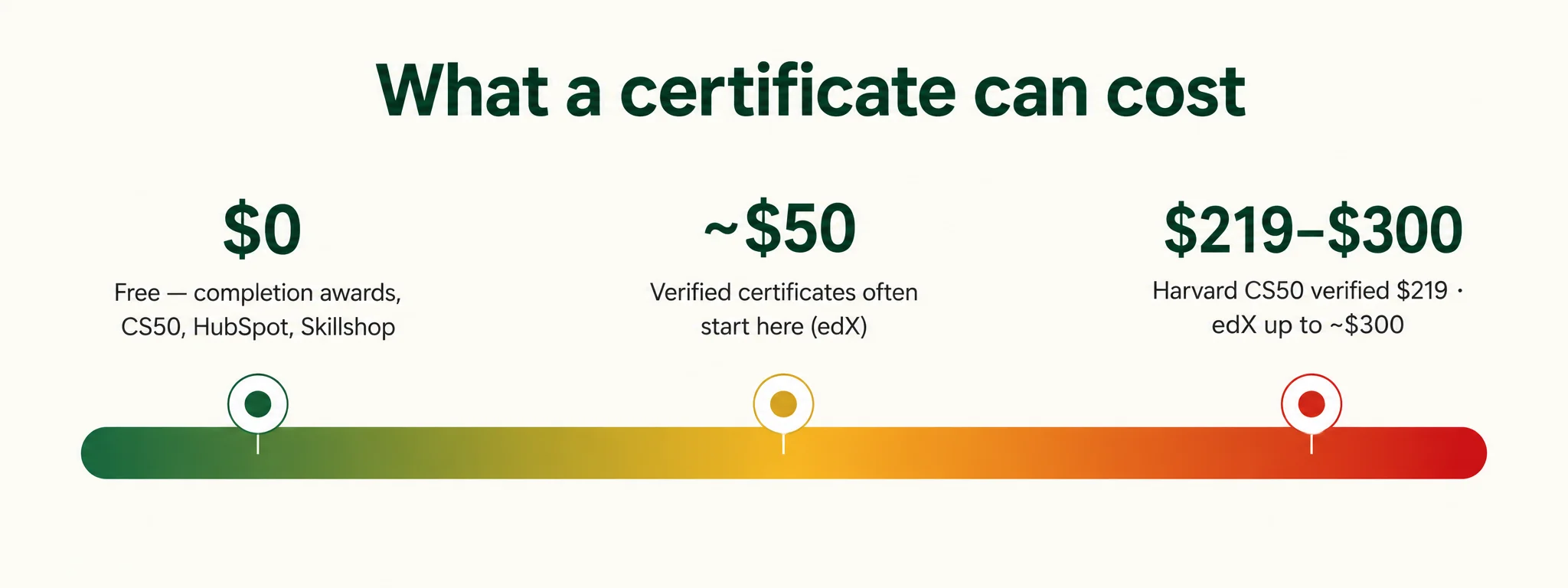
- Free access is often “audit mode.” You can learn the content, but graded items or certificates may be locked behind payment. edX explicitly frames this as “audit for free” vs. “verified certificate for a fee.”
- Free certificates are not guaranteed even if the course content is free. Always read the course’s “upgrade” or “certificate” details before you invest time.
If your goal is free courses with certificate, your best move is to:
- Start with edX (audit first).
- Only pay for a certificate after you confirm the course fits your needs and you can finish it.
- Be skeptical of third-party sites claiming “instant Stanford certificate” (see scam checklist below).
What if I specifically need a free course for digital marketing (Stanford)?
If your search is free course for digital marketing, it’s important to separate Stanford University-branded learning from paid Stanford programs.
For example, Stanford Continuing Studies lists Digital Marketing: Social Media, SEO, Content, and Advertising with tuition ($640), meaning it’s not a free option.
So what can you do for free while still staying Stanford-focused?
- Use Stanford’s free lecture/talk content (often via official Stanford channels) to learn digital strategy concepts, consumer behavior, or analytics thinking.
- For a certificate-driven digital marketing credential, you may need a non-free track—either paid Stanford programs or paid certificate upgrades on MOOC platforms.
How to avoid fake “Stanford free course” offers (fast checklist)
Before you sign up anywhere, verify at least one of these is true:
- The page is on a Stanford domain (e.g., stanford.edu) or an established partner like edX.
- The “free” claim matches the platform’s own wording (e.g., audit for free vs. certificate fee).
- You’re not being asked to pay for “registration processing,” “certificate shipping,” or weird add-ons on a random site.
FAQ
Are Stanford free courses actually taught by Stanford faculty?
Many offerings are taught by Stanford faculty, especially MOOCs and Stanford Engineering initiatives. Stanford Engineering notes online courses are taught by Stanford faculty, and SEE is explicitly Stanford Engineering course material.
Can I get academic credit from a free course stanford?
Usually no. Free MOOCs and open materials are typically non-credit. (Credit-bearing Stanford programs exist, but they are generally paid and have admissions/registration rules.) Stanford’s auditing guidance also emphasizes that audited courses do not provide academic credit.
Is there a truly “free course online with certificate” from Stanford?
Sometimes platforms run promotions, but as a rule, free access ≠ free certificate. edX explicitly separates free auditing from paid verified certificates.
What’s the best way to prove I completed the course if I don’t buy a certificate?
- Keep notes and a study log
- Save completed assignments/projects (especially for SEE-style courses)
- Publish a short portfolio page summarizing what you learned and what you built
Coursera says Stanford has courses—can I take them for free?
Stanford has a Coursera partner page.
However, “free” access rules vary and may be limited (some courses allow limited previews or require trials). Always check the specific course enrollment screen and pricing details.
Disclaimer (please read)
This article is for educational purposes and does not represent Stanford University. Course availability, “free audit” rules, certificate pricing, and enrollment policies can change at any time. Always confirm details on the official Stanford pages or the official course host (e.g., edX) before enrolling.
Stanford University – Free Courses
Stanford Online (Official Portal)
You will be redirected to another website.
Partner Platforms
You will be redirected to another website.
Stanford Engineering Everywhere (SEE)
You will be redirected to another website.
Keep comparing free certificate options
Before you leave, compare one more trusted path and pick the certificate that fits your goal.
Harvard free certificate path Free CS50 certificate — audit free on edX, verified is $219. Free certificate Google certificate options Free Skillshop & Digital Garage awards you can share on LinkedIn. Free certificate Digital marketing certificates Free HubSpot & Google marketing certifications (beginner-friendly). Free certificate MIT free course options Free OCW course materials; MITx certificates on edX from ~$50. Free to audit After you click, a short ad may appear before you continue.