Free Courses with Certificate: Harvard, Google & MIT Compared
If you’re looking for free courses with certificates, Harvard is a strong place to start — especially because CS50 has a free certificate option.
But Harvard is not the only path worth checking. This guide compares Harvard with Google, HubSpot, MIT and Stanford, so you can quickly choose the option that fits your goal.
Compare other free certificate paths
Not sure which one fits you? Pick the goal that matches you and compare another trusted option.
 Google certificate options Free Skillshop & Digital Garage awards you can share on LinkedIn. Free certificate
  Digital marketing certificates Free HubSpot & Google marketing certifications (beginner-friendly). Free certificate
  MIT free course options Free OCW course materials; MITx certificates on edX from ~$50. Free to audit
  Stanford free course options Audit free on Stanford Online & edX; verified certificate is paid. Free to audit
 After you click, a short ad may appear before you continue.
Some courses are free to learn, some include free completion certificates, and others charge only for verified certificates. Start with the comparison below.
Start here: compare the best free certificate paths
- Harvard CS50 — free CS50 certificate option.
- Harvard PLL — official Harvard free course catalog.
- Google Skillshop — practical marketing, ads and analytics certificates.
- HubSpot Academy — beginner-friendly marketing certifications.
- MIT / Stanford — free university-level learning, with certificate limitations.
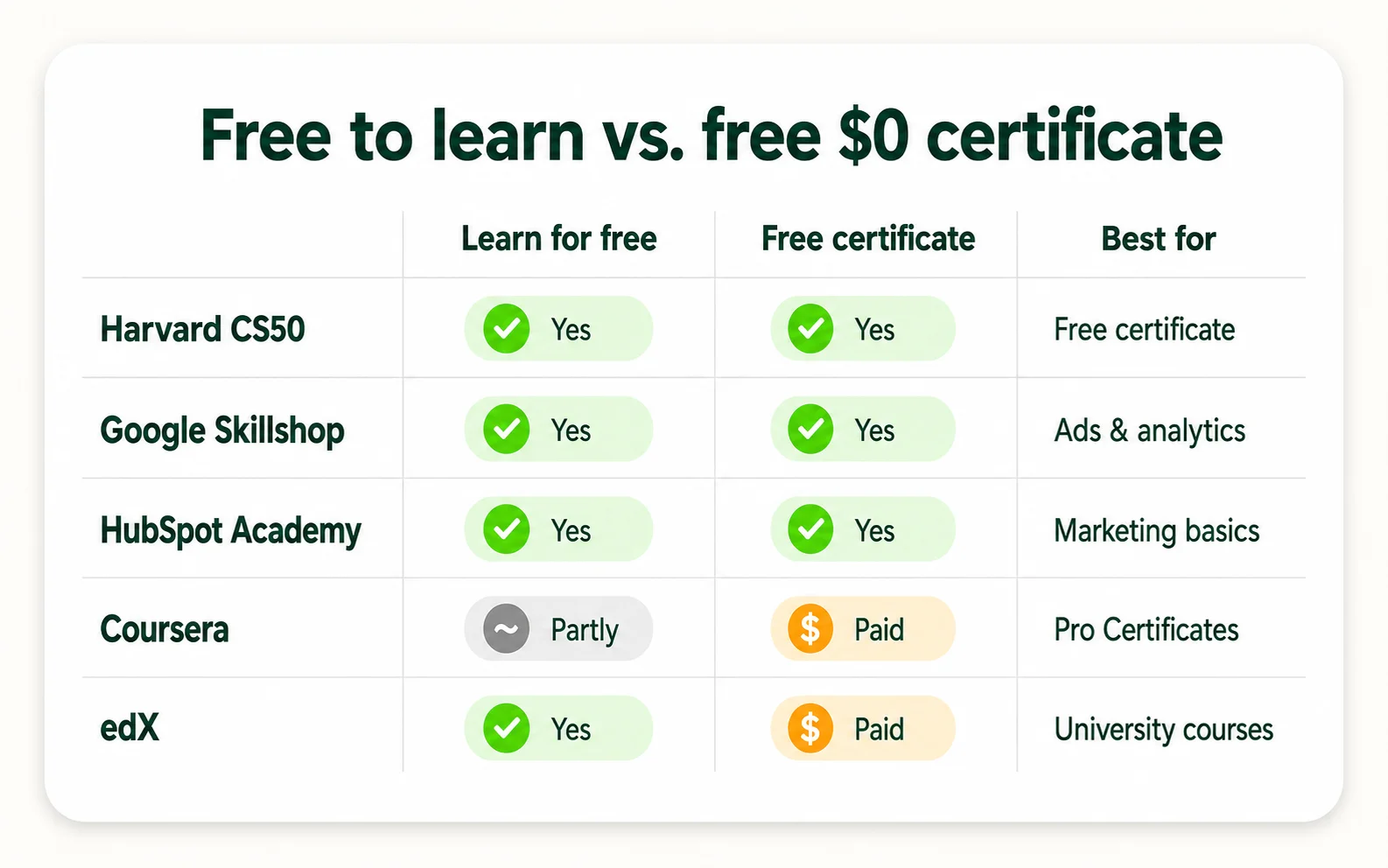
First option: Harvard free courses and certificate paths
Harvard is a strong first stop because it has recognizable course brands, official free course listings, and one especially useful certificate path: CS50. The important part is knowing which Harvard paths are free to learn, which ones include a free course-level certificate, and which ones charge for a verified certificate.
What “free” usually means in Harvard online learning
Harvard lists many offerings as free (often shown as “Free*” in the catalog). In practice, “free” usually means you can access learning materials at no cost, while a verified or platform-issued certificate may require payment or a specific completion path. You’ll see this explicitly on some Harvard course pages (example: CS50’s page describes a free audit option and a paid verified certificate option).
The 2 main certificate types you’ll encounter
Across learning platforms, certificates generally fall into three types — and knowing the difference is what separates a real free credential from a paywall:
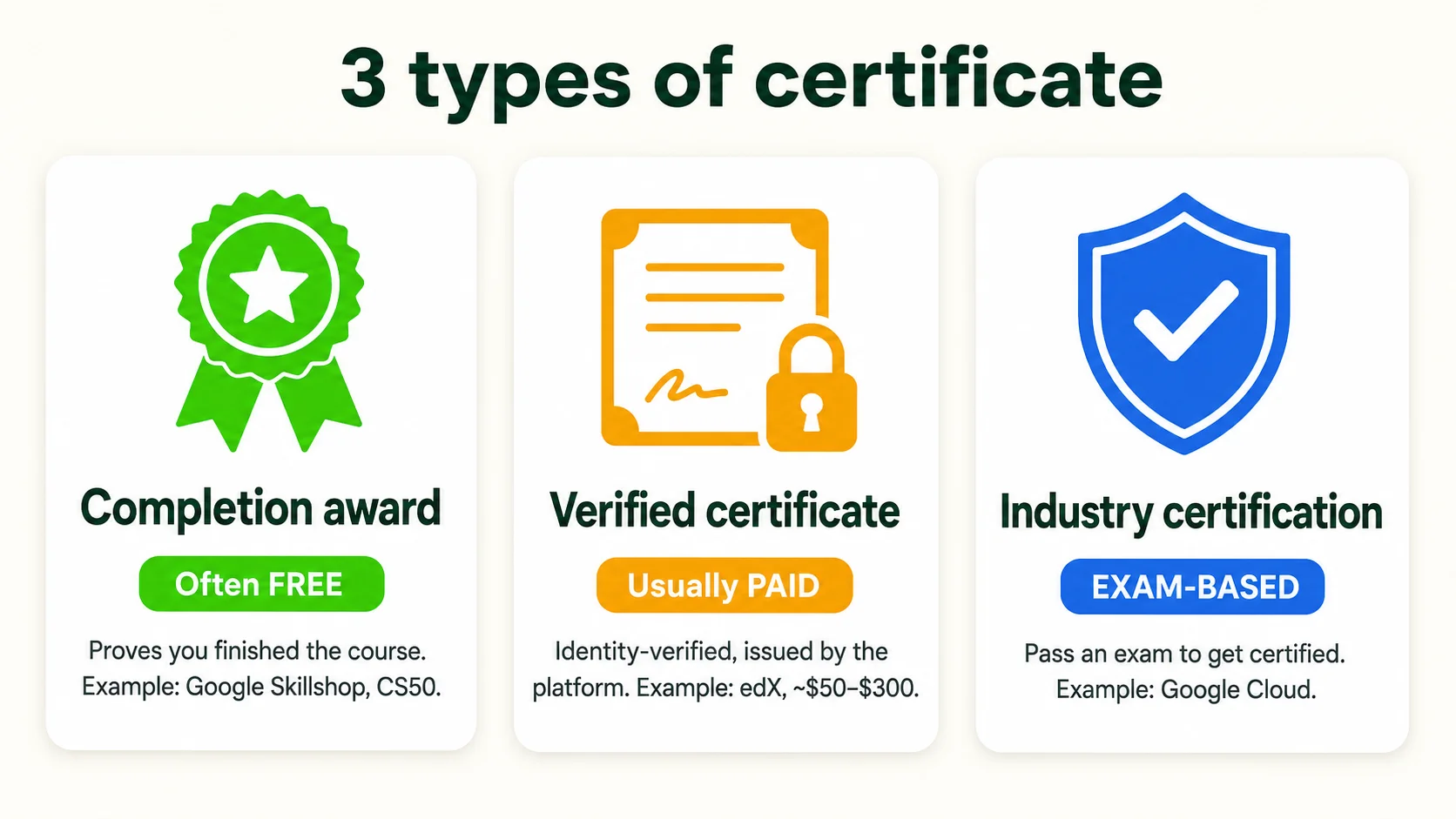
- Platform Verified Certificate (often paid)
On edX, a verified certificate is tied to identity verification and is positioned as proof of successful course completion. - Course/Provider Certificate (sometimes free, course-specific)
Some Harvard-branded courses (notably CS50) offer a free CS50 Certificate issued by CS50 itself, separate from edX’s paid verified certificate.
This distinction is the key to finding genuinely practical “free course certificates online” options while using Harvard courses.
Where to find Harvard’s free courses (official places)
1) Harvard Professional & Lifelong Learning (PLL) — official Harvard catalog
Harvard’s Professional and Lifelong Learning site has a dedicated “Free Courses” catalog with dozens of options across subjects and schools.
Examples currently listed as free include:
- Justice (moral & political philosophy)
- Exercising Leadership: Foundational Principles
- Negotiating Salary (short lesson)
- Data Science series courses like R Basics / Probability (and more)
2) HarvardX on edX — huge catalog, audit is free
edX hosts Harvard University courses under HarvardX. This is one of the largest “Harvard online” ecosystems you’ll run into.
Typical pattern: audit for free, pay if you want the verified certificate.
3) CS50 (Harvard) — the best-known “free certificate” path
CS50’s official FAQs state clearly:
- A CS50 Certificate is a free certificate from CS50 itself — and as of 2026 it’s still offered.
- You earn it by scoring at least 70% on each of the problem sets, labs, and the final project (no payment required).
- A verified certificate can be purchased from edX, and you can still also get the free CS50 certificate.
- There is a “free/audit” option on edX for registration without payment.
At the same time, Harvard Online’s CS50 page explains that the Verified Certificate costs $219, and the audit track does not offer that certificate—reinforcing that you must understand which certificate you’re pursuing. (The free certificate route is on CS50’s own site, cs50.harvard.edu; edX is where the paid verified certificate lives.)
Quick comparison table: Harvard free learning vs certificate paths
| Path | Where you enroll | What’s free | Certificate options | Best for | Watch-outs |
|---|---|---|---|---|---|
| Harvard PLL Free Courses | Harvard PLL catalog | Many courses listed as free | May vary by course/platform | Browsing Harvard topics across fields | Always read the course page for certificate rules |
| HarvardX (edX) | edX HarvardX | Audit often free | Verified certificate usually paid | Broad selection + structured learning | Certificate cost varies; audit may limit graded access |
| CS50 | CS50 + edX registration | Course access free via audit | Free CS50 certificate + optional paid edX verified | If you specifically want a “free course online with certificate” outcome | Must follow CS50 completion requirements precisely |
How to earn certificates (step-by-step, without wasting time)
Step 1) Decide what “certificate” you actually need
Ask yourself:
- Do you need an identity-verified certificate for a job application or HR system? (Often points to edX verified.)
- Or do you need a credible completion certificate to document learning and build momentum? (CS50’s free certificate can be ideal.)
Step 2) Start with a course that matches your certificate goal
If your top priority is free courses with certificate, prioritize CS50-style offerings where the provider explicitly offers a free certificate.
If your priority is “Harvard content first,” pick from the PLL free catalog and then confirm the certificate track on the course page.
Step 3) Understand audit vs verified (edX reality check)
edX positions verified certificates as proof of achievement tied to identity and issued by the institution/platform, while audit is typically the free learning track.
Costs can start around $50 and often range up to a few hundred dollars depending on the course.
Step 4) If cost is the only blocker, consider financial assistance
edX’s help center states that financial assistance can provide an 80% reduction in the verified track fee for learners who demonstrate economic hardship.
This is how many learners turn “learning for free” into “credentialing affordably” when a verified certificate matters.
A practical “Harvard certificate strategy” (what I recommend)
If you want a clean, credible path that won’t disappoint:
- Start with CS50 if you want a genuinely free certificate option
You can earn the free CS50 Certificate (and optionally add the paid verified certificate later). - Use Harvard PLL free catalog to build breadth
Add 1–2 courses aligned to your goals (leadership, humanities, data science, policy). - Only pay for verified certificates when they’ll be used
If the certificate won’t be shared on LinkedIn/resume or required for promotion, prioritize learning outcomes first. edX itself frames verified certificates as most useful when you need proof for employers/schools.
Next options to compare after Harvard
If Harvard is not the best fit for your goal, don’t stop here. The right “free course with certificate” depends on the outcome you want:
- Want a practical marketing or analytics credential? Compare the Google free certificate course options.
- Want a beginner-friendly marketing certificate? See free digital marketing certificate paths.
- Want university-style learning with fewer certificate promises? Compare MIT free course options.
- Want another top university catalog? Check Stanford free course options.
What about “digital marketing” and Google certificates?
You asked to include these terms, so here’s the honest way to fit them into a Harvard-first plan:
- Harvard’s free catalog is strongest in areas like computer science, humanities, leadership, government, and data science.
- If your end goal is a free course on digital marketing with a job-ready certificate, you may want to pair a Harvard course (for credibility + thinking skills) with a free course google certificate program (for tool-based, industry-standard credentials).
That pairing is common: Harvard for foundational thinking and rigor; Google for platform-specific skills that hiring managers recognize quickly.
Considerations Important (read this before you list anything on your résumé)
- Don’t claim you “attended Harvard” just because you completed an online course. Instead, phrase it accurately: “Completed an online course offered by Harvard University / HarvardX.”
- Verify the issuer of the certificate: “CS50 Certificate” (issued by CS50) vs “Verified Certificate” (issued via edX track).
- Check deadlines and access rules: some courses are self-paced, others have session-based runs; completion requirements can be strict. (CS50 explicitly discusses deadlines and certificate requirements in its FAQs.)
- Save proof: download certificates, keep links, and document projects/assignments—your portfolio often matters more than the PDF.
FAQ — Free Harvard courses & certificates
1) Are Harvard online courses really free?
Many Harvard offerings can be accessed for free (often via an audit track or free listing in Harvard’s catalog).
2) Can I get a Harvard certificate for free?
Sometimes, depending on the course. CS50 explicitly offers a free CS50 Certificate from CS50 itself.
3) What’s the difference between a CS50 Certificate and an edX verified certificate?
CS50’s FAQ states the CS50 certificate is free and issued by CS50, while the verified certificate is purchased from edX.
4) Do I need to pay to register for CS50 on edX?
CS50’s FAQ notes there is a “free/audit” option that requires no payment.
5) How much does a verified certificate typically cost?
edX notes verified upgrades can start around $50 and commonly range up to $300 for standalone courses (varies by course).
6) Does edX offer discounts for verified certificates?
Yes—edX’s help center states financial assistance can reduce the verified track fee by 80% for eligible learners.
7) If I audit a course for free, do I still get a certificate?
Often, no. For example, Harvard Online’s CS50 page states the audit track does not offer the verified certificate (that certificate is tied to the paid verified track).
8) Where’s the safest official place to browse Harvard free courses?
Harvard’s PLL “Free Courses” catalog is an official starting point.
Disclaimer
I’m not affiliated with Harvard or edX, and course availability, prices, certificate rules, and financial assistance policies can change. Always confirm details on the official course page before enrolling or paying anything.
You will be redirected to another website.
Sources & references
Details in this guide were checked against the official provider pages. Always confirm on the source before enrolling:
Keep comparing free certificate options
Before you leave, compare one more trusted path and pick the certificate that fits your goal.
Google certificate options Free Skillshop & Digital Garage awards you can share on LinkedIn. Free certificate Digital marketing certificates Free HubSpot & Google marketing certifications (beginner-friendly). Free certificate MIT free course options Free OCW course materials; MITx certificates on edX from ~$50. Free to audit Stanford free course options Audit free on Stanford Online & edX; verified certificate is paid. Free to audit After you click, a short ad may appear before you continue.