Free Certificate Career Paths: Roles & Salaries
I used to frame this page as a map: pick Tech, Marketing, or Business, then follow the order. That undersold what’s actually useful here. The real question isn’t which track to pick — it’s what a free certificate on this site unlocks once you’ve finished it: which entry-level roles it can get you an interview for, what those roles typically pay according to sources like the Bureau of Labor Statistics and Glassdoor, and where a paid credential becomes the honest next step.
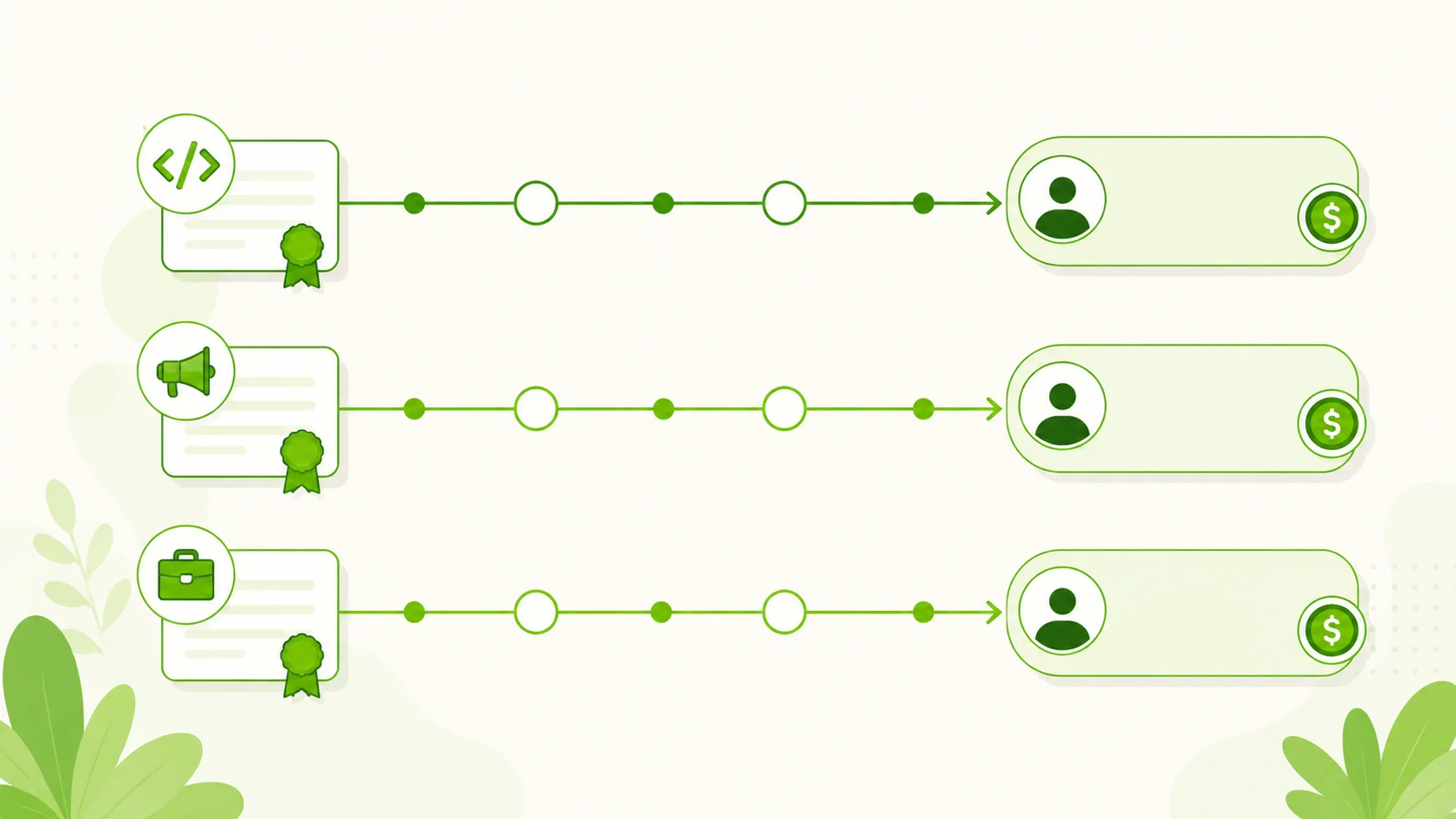
So this is a page about outcomes now, not just order. Each track lists the entry-level roles it feeds, a typical US salary range (attributed, never invented, flagged for verification where I lack a confirmed figure), and a note on how many roles are advertised as remote jobs — which matters if you’re reading this from South Africa or anywhere outside a US metro area. One disclaimer up front, repeated in every track: a free certificate is the first step toward an interview, not a contract for a job title or a paycheck. If you haven’t already, start here for the five certificates I’d take before any track below.
Jump to: Tech & Data · Marketing · Business
Tech track: from CS50 to a cloud computing certification
This is the path I’d recommend to anyone switching into software, data, or IT — even with zero coding background. It starts free and stays free for a long time before you hit any paywall.
| Certificate | Typical time | Free status | Where to start |
|---|---|---|---|
| Harvard CS50 (CS50x) | Self-paced; commonly spread over a few months of part-time study | 100% free certificate, issued by CS50 itself | Harvard CS50 guide |
| MIT OpenCourseWare | Self-paced, varies by course | Free content, no certificate at all | MIT OCW guide |
| freeCodeCamp certifications | ~300 hrs per certification, self-paced | Completely free, including the certification | freeCodeCamp.org |
| Kaggle micro-courses | 3-5 hrs each | Free | kaggle.com/learn |
| Google Data Analytics Certificate | ~3-6 months part-time | Free to audit; certificate needs a Coursera subscription (~$49/mo) or approved financial aid | Google certificates guide |
I put CS50 first because it’s the only item here where the certificate itself — not just the content — is free, no financial aid application required. Once you’ve finished it, freeCodeCamp is the natural next step for building actual projects, and MIT OpenCourseWare is worth browsing for depth even though it hands you zero credential. Stanford’s free and audit-only courses are a good third stop once you know which corner of computer science you like.
What this track unlocks: entry-level roles and pay
Here’s what these certificates realistically feed into, once you’ve put in the hours:
| Entry-level role | Typical US salary range (source) | A free certificate that helps |
|---|---|---|
| IT Support Specialist | About $45,000–$75,000 (BLS median ~$60,340, 2024) | Google IT Support Certificate, via the Google certificates guide |
| Junior Data Analyst | About $60,000–$90,000 for junior roles (Glassdoor, 2026) | Google Data Analytics Certificate |
| Cloud Support Associate | About $75,000–$120,000 (Glassdoor, 2026; AWS roles higher) | Free vendor training tiers, ahead of a paid cloud computing certification |
None of this is a guarantee. A free certificate gets your resume a second look — it doesn’t sign an offer letter. What I will say is that several of these, especially data analyst and cloud support positions, show up constantly as remote jobs, worth knowing if you’re applying from outside a US city.
Where a data analytics certification and a cloud computing certification fit
Once you have CS50 and a couple of freeCodeCamp certifications behind you, two common next moves are a data analytics certification and a cloud computing certification. Here’s the honest version of both.
The Google Data Analytics Certificate (listed above) is the most accessible on-ramp — you can audit every lesson for free, and the certificate itself is achievable without paying if you qualify for Coursera’s financial aid program. It won’t make you a data scientist, but it’s a legitimate, LinkedIn-visible signal that you know SQL, spreadsheets, and Tableau basics — usually the credential behind that junior data analyst salary range above.
A cloud computing certification is a different animal. AWS certification exams (and the equivalent Microsoft or Google Cloud exams) are paid — pricing is set by the vendor and changes, so check the official page before you register. I do recommend using the free training tiers these vendors publish — AWS Skill Builder alone offers hundreds of free courses — to prep before spending a cent on an exam voucher: treat the free courses as the studying, and the paid exam as the thing you sit once you’re confident you’ll pass.
A cybersecurity certification, the honest version
Same pattern applies to a cybersecurity certification. Cisco Networking Academy’s “Introduction to Cybersecurity” course is genuinely free and issues a real Cisco/Credly digital badge — a solid first credential that costs nothing. Professional cybersecurity certifications that carry more weight with hiring managers, like CompTIA Security+ (around $400–$440) or CISSP ($749, and it expects five years of experience), are paid exams with their own prerequisites, and most expect hands-on experience first. I’d start with the Cisco badge, add IBM SkillsBuild’s security modules, and only look at a paid exam once you’ve confirmed the field is a fit and checked the certifying body’s own page for current cost and requirements.
Marketing track: from HubSpot to Google’s Digital Marketing certificate
This is the shortest path to something you can put on a resume in under a month, because most of these courses are 4-10 hours each.
| Certificate | Typical time | Free status | Where to start |
|---|---|---|---|
| HubSpot Academy (Inbound, Content Marketing, Email Marketing) | 4-10 hrs each | Free, but not externally accredited | academy.hubspot.com |
| Google Skillshop (Google Ads, GA4) | 4-8 hrs each | Free, renews yearly, LinkedIn-shareable | skillshop.withgoogle.com |
| Semrush Academy | A few hours | Free certificate after passing the exam, renews yearly | academy.semrush.com |
| Google Digital Marketing & E-commerce Certificate | ~3-6 months part-time | Free to audit; certificate needs a Coursera subscription or approved financial aid | Digital marketing guide |
I’d start with HubSpot because it’s free start to finish and you can stack three or four short certifications in a weekend. Google Skillshop is next because Google Ads and GA4 badges are what I actually see recruiters recognize on sight — specific, verifiable, and renewed every year so they stay current. The Google Digital Marketing & E-commerce Certificate is the deepest of the four, and it’s the one where the honest caveat matters most: you can learn the entire curriculum for free by auditing, but the shareable certificate sits behind that Coursera subscription unless financial aid comes through.
What this track unlocks: entry-level roles and pay
| Entry-level role | Typical US salary range (source) | A free certificate that helps |
|---|---|---|
| Social Media / Marketing Coordinator | About $48,000–$74,000 (Glassdoor/Indeed, 2026) | HubSpot Academy (Social Media, Content Marketing) |
| SEO / PPC Specialist | About $55,000–$95,000 (Glassdoor/Indeed, 2026) | Semrush Academy SEO certificate and Google Skillshop Ads |
| Digital Marketing Specialist | About $50,000–$75,000 (ZipRecruiter/PayScale, 2026) | Google Digital Marketing & E-commerce Certificate |
Same disclaimer as the tech track: a HubSpot badge or a Skillshop certification earns a second look, not a promise of an interview or a salary. Marketing coordination and content roles are also among the most commonly listed remote jobs in the US right now — good news if you’re job-hunting from South Africa without relocating.
Business track: from free badges to a real agile certification
This path is for people aiming at project coordination, operations, or a general management role. It ends at the same fork as the other two tracks: free training first, a paid credential only if it’s worth it.
| Certificate | Typical time | Free status | Where to start |
|---|---|---|---|
| HubSpot Academy (Sales, Customer Service) | 4-8 hrs each | Free | academy.hubspot.com |
| OpenLearn / Open University badged courses | A few weeks, self-paced | Free digital badge + Statement of Participation; many are CPD-accredited | open.edu/openlearn |
| Google Project Management Certificate | ~3-6 months part-time | Free to audit; certificate needs a Coursera subscription or approved financial aid | Google certificates guide |
| Agile and Scrum fundamentals (inside the PM certificate) | Included in the course above | Free to audit; a standalone, proctored agile certification is a separate paid exam | — |
The Google Project Management Certificate is the centerpiece here, and it teaches both waterfall and agile approaches, including a real Scrum module — a genuinely useful, free preview of what an agile certification exam covers, but not the certification itself. If agile project management is your lane, the next step is a paid, proctored credential from an organization like Scrum.org or PMI; treat this table as preparation for that decision, not a replacement for it.
What this track unlocks: entry-level roles and pay
| Entry-level role | Typical US salary range (source) | A free certificate that helps |
|---|---|---|
| Project Coordinator | About $50,000–$78,000 (Glassdoor, 2026) | Google Project Management Certificate |
| Operations Coordinator | About $47,000–$70,000 (Glassdoor/Indeed, 2026) | HubSpot Academy (Sales, Customer Service) |
| Junior Business or Operations Analyst | About $63,000–$102,000 (Glassdoor, 2026) | OpenLearn badged courses plus the Google Project Management Certificate |
Project coordination and operations roles are also frequently listed as remote jobs, especially at SaaS companies hiring across time zones. And as with the other two tracks, none of these free credentials guarantee a hire — they get your application read, not signed.
I’ll say the same thing here that I’d say to anyone eyeing an online MBA program: none of these free badges are a substitute for one. Tuition varies enormously by school — an online MBA typically runs from about $20,000 to well over $130,000 and takes one to three years — making it a much bigger financial and time commitment than anything else on this page. This business track is good for testing, cheaply and quickly, whether strategy, operations, or project management is a field worth that investment later.
How to choose if you’re not sure
If you genuinely don’t know which track fits, here’s the shortcut I’d use:
- You like logic puzzles, or you’re curious how apps work → Tech track. Start with CS50.
- You like writing, or analyzing what makes people click → Marketing track. Start with HubSpot Academy.
- You like organizing people, timelines, and budgets → Business track. Start with HubSpot’s Sales or Service courses, then the Google Project Management Certificate.
Whichever you pick, don’t skip the fundamentals. A free badge from an unfamiliar platform can be a legitimate credential or a waste of a weekend, and the difference isn’t always obvious — if you haven’t gone through it yet, revisit my start-here guide to the first five certificates. And once you’ve picked a track, read which certificates recruiters actually respect so you know what to prioritize when time is short.
Frequently asked questions
Do I have to finish an entire track before I apply for jobs?
No. A single strong certificate — CS50, the Google Data Analytics Certificate, or a couple of HubSpot badges — is enough to add to a resume or LinkedIn profile while you keep working through the rest of the track. I wouldn’t wait until you’ve finished everything here.
Are any of these the same as a college degree or a professional license?
No, and I want to be direct about that. Most of what’s listed here is a skills credential, not an accredited degree or a licensed qualification. A free HubSpot badge or a Google certificate shows initiative and verifiable skills — it isn’t a substitute for a bachelor’s degree, a PMP certification, or an online MBA program.
What if I can’t afford the Coursera subscription for a Google certificate?
Apply for Coursera’s financial aid before assuming it’s out of reach. It’s a legitimate free path for the Google Career Certificates, but it requires an application and approval — don’t count on it being automatic. Apply early, and keep auditing the lessons free while you wait.
Can I mix tracks, like Tech and Marketing?
Yes, and a lot of people do — digital marketing overlaps with data analytics more than you’d expect. I’d still finish one track first so you have a coherent story for a resume, then borrow from the second once the first is done.
If you want a concrete week-by-week schedule instead of just an order of operations, I laid one out in my 30-day certificate plan.
Start on your track
Official pages for the core free courses in each track above.


These links open the official provider on another website.