Free Certificates Recruiters Actually Respect
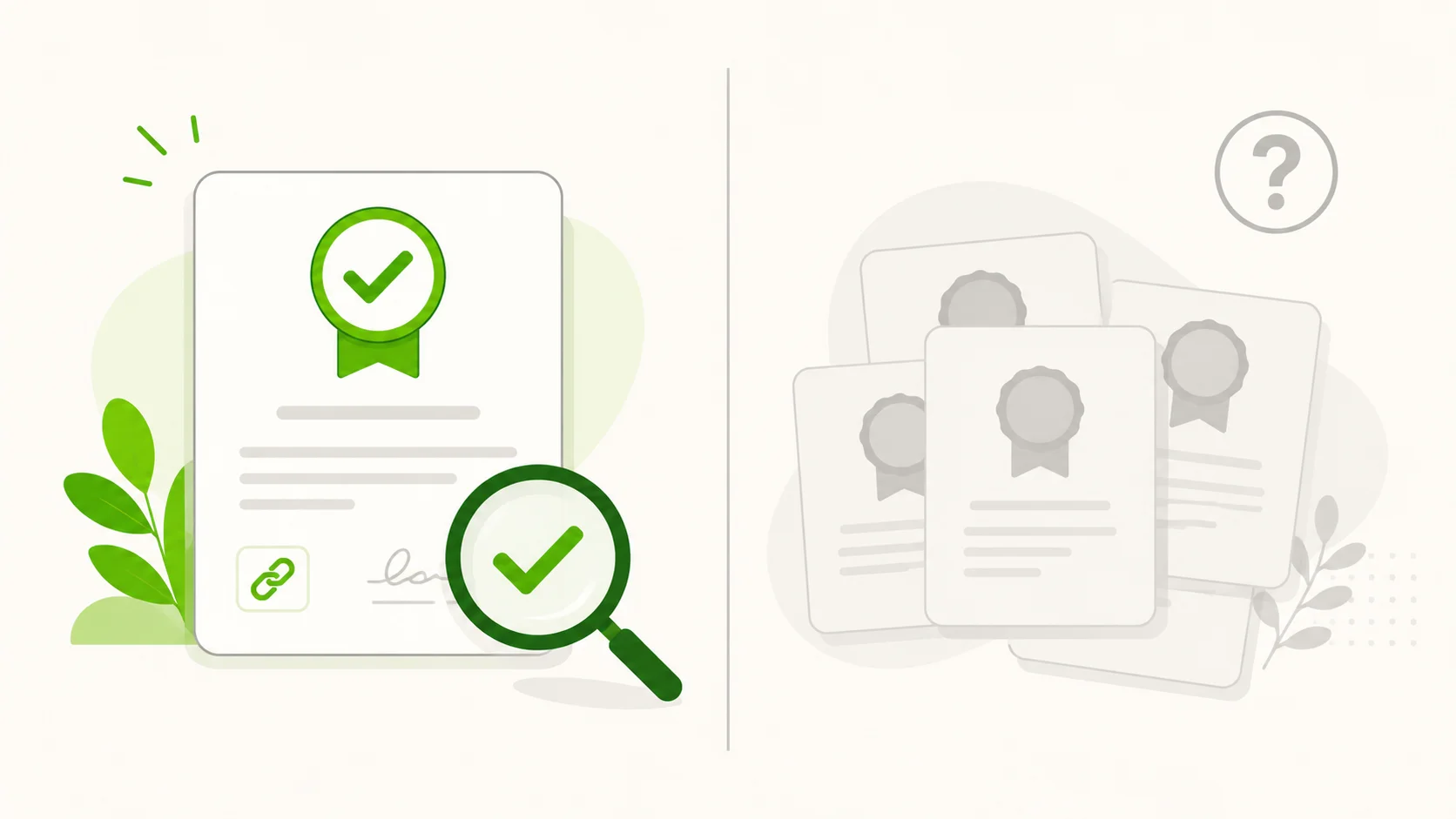
Here’s the honest truth: most free certificates do nothing for you in front of a recruiter. A PDF badge from a course you skimmed in a weekend, sitting next to zero evidence you can actually do the work, reads as noise. I’ve looked at enough LinkedIn profiles and talked to enough hiring managers to know that the credential itself rarely moves the needle — what moves it is whether you can talk about the project for five minutes without notes.
But a small number of free certificates do carry real signal, and it’s worth knowing exactly which ones and why, so you stop wasting hours on the ones that don’t. Below I’ve organized the free certificates that actually land, by career area, plus the honest ceiling on all of them: none of these replace a paid credential like an online MBA, a PMP certification, a scrum master certification, or an HR certification. They’re stepping stones — proof of initiative and a specific, demonstrable skill — not substitutes.
If you haven’t picked a starting point yet, I’d read which five certificates to get first before you go further down this list — it’ll save you from chasing the wrong ones.
Tech & Data: The Free Certificates Hiring Managers Actually Check
In tech, recruiters and hiring managers are used to seeing a wall of course badges that mean nothing. The ones below survive scrutiny because they force you to build something or pass a real test, not just click “next” through video lectures.
Harvard CS50. The CS50 Certificate is genuinely free — even the paper — issued directly by CS50 at cs50.harvard.edu, no catch. It’s respected because CS50’s problem sets are hard, and anyone who’s hired a CS50 grad knows it. If a recruiter asks about it, you can talk through pset8 or your final project in real detail, which is the whole point.
freeCodeCamp certifications. These are free, self-paced, and every certification requires you to ship actual working projects — a portfolio site, a JavaScript algorithm library, a full-stack app. A recruiter who clicks through to your GitHub sees real commits, not a completion screenshot. That’s what makes it land: it’s verifiable outside the badge itself.
IBM SkillsBuild / Cognitive Class and Cisco Networking Academy. Both issue free, Credly-verified digital badges (IBM SkillsBuild, and Cisco’s Python Essentials or Introduction to Cybersecurity). They display natively on LinkedIn with a “verify” link that goes to a real issuing body, not a course platform’s internal badge system. For an entry-level data or IT role, that verification link matters more than people think — it tells a recruiter the badge isn’t self-issued.
Kaggle micro-courses and Google Skillshop’s technical modules round this out for data roles specifically — short, free, and each one maps to a skill you can be quizzed on in an interview.
Marketing: The Closest Free Path to a Digital Marketing Certification
Marketing is the one area where a truly free credential can sit reasonably close to a paid digital marketing certification, mostly because the two biggest platforms — Google and Semrush — give away the same exam that professionals pay to prepare for.
Google Skillshop (Google Ads, Google Analytics/GA4). These are completely free, renew yearly, and are LinkedIn-shareable. They’re respected specifically because agencies require them — a PPC or analytics manager will ask if you’re Google Ads certified before they ask about your portfolio. Renewing it yearly is also a quiet signal that you’re still active, not that you passed a test once in 2022 and forgot everything.
Semrush Academy. Free, and you get a real certificate after passing the exam (also renews yearly). Semrush’s SEO and content marketing courses are used inside actual marketing teams, so naming a Semrush cert in an interview gives you something concrete to discuss — keyword gap analysis, technical audits, whatever you actually did in the practice account.
Google Career Certificates (Digital Marketing & E-commerce). These live on Coursera, and I want to be precise about the terms: there’s a 7-day free trial, after which it’s a paid Coursera subscription (roughly $49/month) unless you apply for and receive Coursera financial aid, which is a legitimate free path but requires an application and approval — it isn’t automatic. Auditing the lessons is free, but auditing alone doesn’t produce the certificate.
I go deeper on which digital marketing credentials are actually worth the time in my full breakdown of free digital marketing courses, and I’ve separately audited Google’s whole certificate lineup — trial terms, financial aid, and all — in my review of Google’s free certificates.
Business: Free Badges That Hint at a PMP or Scrum Master Certification — Without Replacing One
This is where I have to be the most direct, because business credentials are where free badges most often get oversold.
OpenLearn (The Open University). Free, and many of its short courses are CPD-accredited, which means they map to continuing professional development hours that some UK and international employers actually track. You get a free digital badge and a Statement of Participation. For project management, leadership, or HR-adjacent topics, this is one of the few free options with an accreditation body behind it rather than just a platform’s internal seal.
HubSpot Academy. Free, well-produced, and covers real operational skills — inbound marketing, sales enablement, CRM administration. I’ll be straight with you: it is not externally accredited. It’s HubSpot vouching for HubSpot. That doesn’t make it useless — a HubSpot certification tells a hiring manager you can actually run their CRM on day one, which is a specific, demonstrable skill — but don’t present it as equivalent to a third-party credential.
Elements of AI (University of Helsinki). Free, university-issued, and increasingly relevant for business roles that touch AI tooling. It won’t get you an AI job on its own, but it’s a legitimate university credential, not a marketing badge, which puts it a notch above most “free AI certificate” offers you’ll see advertised.
None of these three are a substitute for a paid online MBA, a PMP certification, a scrum master certification, or an HR certification like SHRM or PHR — and I’d be lying to you if I implied otherwise. What they do is prove you’ve studied the vocabulary and frameworks those paid credentials formalize, which is genuinely useful when you’re the candidate without the budget for a $3,000 scrum master course but you can still speak the language in an interview.
What Does Not Impress Recruiters
I’d rather tell you this plainly than let you waste a weekend.
- Certificate-mill badges — sites that let you “pass” after watching a video with no real assessment, no project, and no verification link. Recruiters who’ve been doing this for a while can spot these instantly.
- Anything you can’t talk about. If someone asks “walk me through what you built” and you go blank, the certificate actively hurts you — it signals you collected credentials instead of skills.
- “Audited but no credential.” Auditing a free course on edX or Coursera is genuinely valuable for learning, but it produces nothing you can put on a resume as a completed certificate. Don’t list a course you audited as if you finished it — that’s the fastest way to lose trust in an interview.
- A pile of unrelated badges. Ten disconnected certificates read as scattered, not ambitious. Three related ones that build toward one career path read as focused.
The Honest Comparison
| Certificate | Area | Why it lands with recruiters | Honest limitation |
|---|---|---|---|
| Harvard CS50 Certificate | Tech / CS fundamentals | 100% free, issued by CS50 itself, backed by genuinely hard problem sets | Not a degree; the edX verified add-on (~$219) is separate and paid |
| freeCodeCamp certifications | Tech / dev | Requires shipped projects you can show and discuss | Self-paced with no institutional name recognition |
| IBM SkillsBuild / Cisco Networking Academy | Tech / IT & data | Credly-verified, third-party issued, checkable link | Entry-level scope; won’t carry a mid-level application alone |
| Google Skillshop (Ads, GA4) | Marketing | Industry-standard, agencies actually require it, renews yearly | Narrow — proves one tool, not marketing strategy overall |
| Semrush Academy | Marketing / SEO | Real exam, real certificate, used inside real marketing teams | Semrush-specific; not a substitute for a broader marketing degree |
| Google Career Certificates | Marketing / Data / IT / PM | Coursera-hosted, structured, project-based | Paid subscription after 7-day trial unless financial aid is approved |
| OpenLearn (Open University) | Business / general | Free, and many courses are CPD-accredited | Statement of Participation, not a full academic qualification |
| HubSpot Academy | Business / marketing ops | Proves you can run real CRM/inbound workflows | Not externally accredited — it’s HubSpot certifying HubSpot |
Once you’ve picked your two or three, the next question is presentation — I cover exactly how to list them so they read as evidence, not decoration, in how to show your certificates on LinkedIn and your resume.
Do recruiters actually check free certificates on LinkedIn?
Some do, especially for entry-level and career-change roles, and especially when the certificate has a verification link (Credly, CS50’s own verification page, Semrush’s exam record). Most won’t click through on every badge, but they will ask about one or two in an interview — which is why being able to discuss the work matters more than the badge count.
Is a free Google Career Certificate as credible as the paid Coursera subscription version?
They’re the same certificate — Google doesn’t issue a “lesser” free version. The difference is only in how you paid for it: through the 7-day trial before it converts to a subscription, or through approved Coursera financial aid. Either path produces the identical credential.
Can any free certificate replace a paid credential like a PMP or an online MBA?
No, and I wouldn’t want to mislead you into thinking otherwise. Free certificates prove initiative and a specific skill; paid, accredited credentials like a PMP certification, a scrum master certification, or an online MBA involve formal exams, experience requirements, or accreditation bodies that free badges simply don’t have behind them. Use the free ones to build toward the paid ones, not to skip them.
Which free certificate should I start with?
It depends on your target role, but I’d start with whichever one has the clearest verification link and the most demonstrable output — CS50 or freeCodeCamp for tech, Google Skillshop for marketing, OpenLearn for business. I map out a full sequence, in order, in my starter guide to the first five certificates worth getting.
If you want to see how these free credentials fit into a real career trajectory rather than a random list, my free certificate career paths guide breaks it down by target job.
Earn the ones that actually count
The free credentials I called out above — straight to the official page for each.
 Google Skillshop
  HubSpot Academy
  Semrush Academy
  Harvard CS50
  freeCodeCamp OpenLearn (Open University)
 These links open the official provider on another website.